

Communications Surveillance in 2026: Is your tech stack up to the task?

Over the past few years, communications risk has expanded faster than most compliance frameworks can keep up.
Across financial services, and other regulated businesses, the growth of mobile, messaging, and collaboration platforms has fundamentally changed how regulated conversations take place. Employees are no longer communicating through a handful of monitored channels. Today’s business conversations happen across mobile voice, messaging platforms like WhatsApp, collaboration tools such as Teams and Zoom, personal devices and social and hybrid digital communication environments.
At the same time, regulatory scrutiny and expectations are increasing, particularly around off-channel comms, record-keeping obligations, data governance, behavioural monitoring and surveillance effectiveness.
It’s no longer enough to simply capture communications. Regulators now expect firms to demonstrate that they can monitor risk effectively, adapt to new channels quickly, investigate activity efficiently and maintain full audit visibility across an increasingly complex communications landscape.
In short, communications surveillance must move from passive monitoring to active control.
The Limitations of Traditional Surveillance Frameworks
Many firms have invested heavily in surveillance technology over the years. Yet despite this, compliance teams are under growing pressure.
The reality is, many surveillance systems and processes were built for a simpler world - one with fewer channels, lower volumes, and more predictable communication patterns.
Today, compliance teams often face:
- Fragmented capture and surveillance systems
- High manual review volumes
- Poor alert quality and high false positives
- Limited visibility across newer communication channels
- Inflexible legacy infrastructure
- Difficulty adapting to new misconduct risks
The result is often a surveillance framework that doesn’t truly provide control and the flexibility, intelligence or scalability needed to manage today’s communication risk effectively. And in a landscape where enforcement is increasingly focused on behavioural oversight, that gap matters.
The Shift Toward Integrated Communications Surveillance
Forward-looking firms are starting to rethink what “good” communications surveillance looks like, and are moving beyond siloed models toward integrated, adaptable frameworks.
In 2026, an effective and resilient communications surveillance programme is defined by:
- Omnichannel capture across voice, mobile and digital messaging
- Integrated capture, surveillance and case management
- AI-enhanced detection and prioritisation
- Configurable workflows and governance controls
- Full auditability and regulatory transparency
- The flexibility to scale with new channels and regulations
Rather than reacting to risk, modern surveillance programmes are designed to anticipate it. This shift reflects a broader industry move from static monitoring and fragmented oversight to dynamic, scalable control. Firms need confidence that risks can be detected early, reviews are efficient, evidence is regulator-ready and new communication behaviours won’t create blind-spots.
The Importance of Strong Data Governance
As surveillance becomes more intelligent and AI-driven, the underlying data that powers it is moving into sharper regulatory focus.
Organisations will increasingly be expected to demonstrate not just that they monitor communications, but that they govern the data behind those insights responsibly.
Regulators will be digging into:
- Where communications data is stored
- How it is accessed
- How long it is retained
- How AI models are trained and applied
- Whether surveillance decisions can be fully explained
Without strong data governance, even advanced surveillance capabilities can create new risks, from cross-border compliance exposure to opaque AI decision-making.
Forward-looking organisations are therefore extending their surveillance strategy beyond detection alone to encompass data control, ensuring their data foundations are transparent, secure, configurable and regulator ready.
Benchmarking your Current Systems
To help compliance leaders assess where they stand today, and support them in navigating this transition, we’ve developed a practical self-assessment tool:
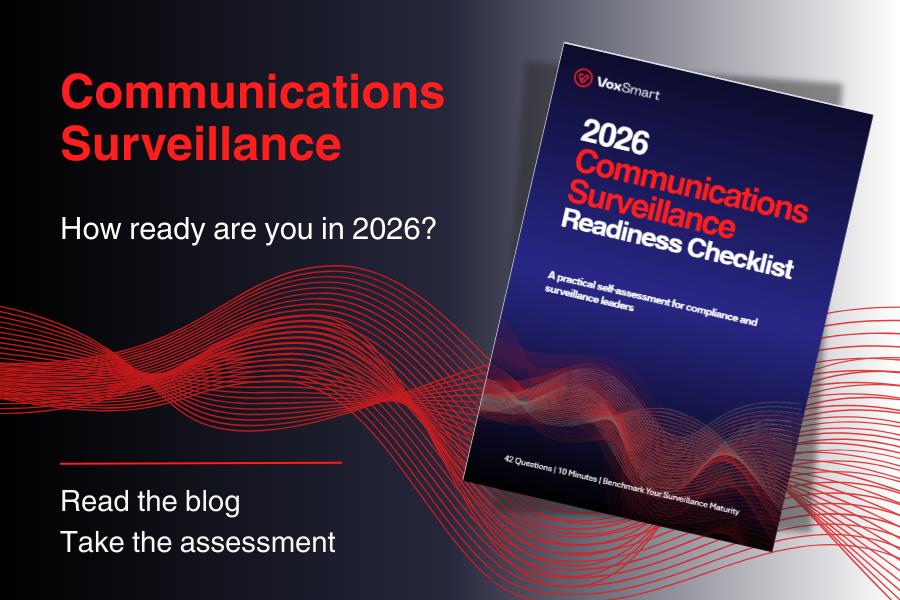
The 2026 Communications Surveillance Readiness Checklist
This structured checklist helps firms evaluate their surveillance maturity across seven key pillars:
- Channel coverage
- Surveillance effectiveness
- AI and automation readiness
- Governance and auditability
- Operational resilience
- Future scalability
- Data governance
Each section includes a scoring framework, enabling organisations to benchmark their current state and identify potential gaps.
> Download the 2026 Communications Surveillance Readiness Checklist
The checklist highlights the capabilities increasingly expected of future-ready surveillance environments.
1. Channel Coverage
Are all regulated or high-risk communications captured and retained appropriately, including mobile and messaging platforms?
2. Surveillance Effectiveness
Do surveillance processes meaningfully detect misconduct, or simply generate noise?
3. AI & Automation
Are detection models actively learning, improving accuracy and reducing manual review burden?
4. Governance & Auditability
Can decisions, alerts and reviews be clearly explained to regulators?
5. Operational Resilience
Will your surveillance programme scale as volumes and channel scope grow?
6. Future Readiness
Can your surveillance framework adapt to emerging communication channels and evolving regulations?
7. Data Governance
Is your communications data controlled, explainable and aligned to sovereignty requirements?
Understanding Your Maturity Level
Using the checklist scoring model, organisations can identify their surveillance maturity across four stages:
🔴 Fragmented (0-35) – Reactive, limited visibility and high regulatory exposure
🟠 Developing (36-65) – Foundational controls in place, but inconsistent
🟡 Controlled (66-90) – Strong oversight, but with some flexibility constraints
🟢 Future-Ready (91-105) – Integrated, intelligent and regulator-aligned
For many organisations, the exercise highlights a key reality: The biggest challenge is no longer simply capturing communications, it’s managing them effectively at scale while the goalposts are constantly shifting.
The Next Generation of Communications Surveillance
As communications ecosystems continue to evolve, surveillance programmes must do the same.
Organisations that prioritise flexibility, integrated oversight, intelligent detection & management and strong operational control and data governance will be best positioned to manage risk and meet regulatory expectations without overwhelming their compliance teams.
The 2026 Communications Surveillance Readiness Checklist provides a practical starting point for that journey.
If you’d like to discuss your results or explore how to strengthen your surveillance framework, our compliance specialists are happy to help. Get in touch

